A 3-Mg Psychedelic Dose in a Minimally Conscious Brain: One Case
London, 2024. 10:03 a.m.
A woman who hasn’t spoken in six years just took a micro-dose of psilocybin. Thirty-four minutes later her brain lit up like a healthy tripping volunteer’s—yet she still couldn’t squeeze your hand on command. The EEG says “something happened”; the bedside exam says “nothing has changed.”
That paradox is the entire story.
When “awake” and “aware” stop meaning the same thing
Minimally Conscious State is a cliff edge: a patient may track a mirror once or blink twice on request, then vanish again. Diagnosis takes days of repeated exams—the London woman scored 7/23 on the Coma Recovery Scale at baseline and 7/23 again three hours after the drug. The only upward line was on a computer screen.
Entropy is easy; meaning is hard
Researchers once equated “more brain chaos” with richer experience. The newer view counts unique patterns instead of sheer disorder. Lempel-Ziv complexity compresses an EEG like a zip file: the more distinct “words” it needs, the busier the brain.
The woman’s global complexity jumped 15 %—the same leap seen in volunteers on a full 20 mg dose. But the brain that can juggle more patterns still couldn’t answer “Are you there?”
A broken staircase
Robin Carhart-Harris maps consciousness in three floors:
1. Raw sentience—just feeling.
2. Reflection—knowing you’re feeling.
3. Ego—the story that strings moments together.
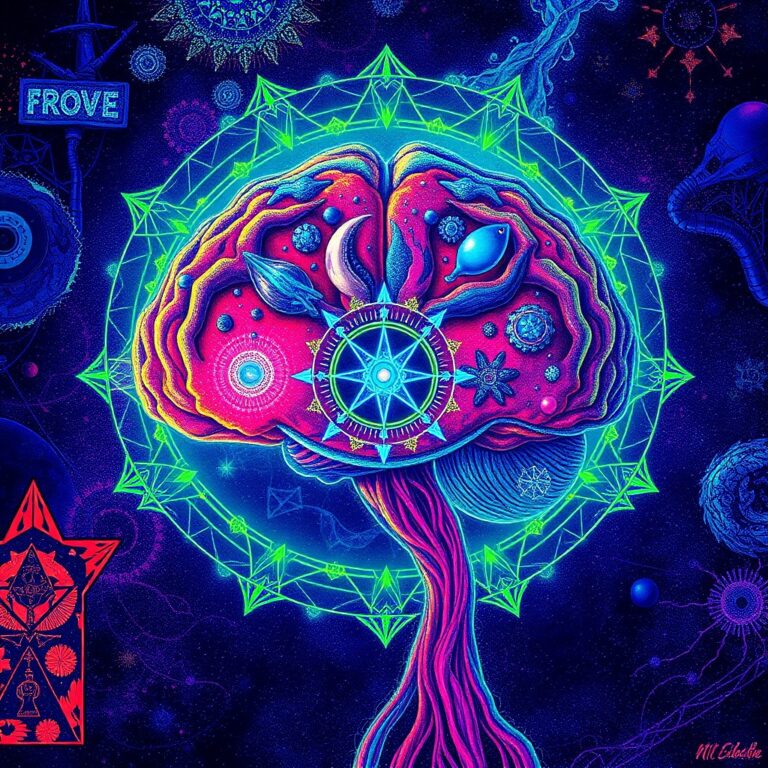
Psilocybin in healthy brains shakes the top floor while sometimes brightening the basement. In MCS the staircase is rubble. Gamma bursts flashed, but the long-range cables needed to weave them into a self were gone. Lights on; no one home.
The ethics of a single blip
One patient, no placebo, dose the size of a lentil. Parental consent came under a compassionate-use clause usually reserved for terminal cancer. The ethics board met for months over a single question: is offering possibility a kindness or a cruelty? False hope in MCS has real casualties—families sell houses for stem-cell pilgrimages or wrestle courts over feeding tubes.
The authors end with a whisper in all-caps: “No change in clinical status was observed.”
Frequently asked questions
Q: Does this mean psilocybin can “wake up” coma patients?
A: No. One EEG changed; clinical tests did not. The study is N = 1 and explicitly not evidence of efficacy.
Q: Could the EEG change be placebo or random fluctuation?
A: The rise occurred only during the drug window relative to same-day baseline. Without placebo, expectancy effects remain possible.
Q: Are there ongoing trials for psilocybin in disorders of consciousness?
A: As of May 2025, none recruiting. Imperial College is planning a safety pilot but hasn’t opened enrollment.
Q: My loved one is in MCS. Should I ask about psilocybin?
A: The drug is not approved for this indication and is illegal outside research settings. Families can call or text the 988 Suicide & Crisis Lifeline (US) or local equivalents for support.
Q: How is Lempel-Ziv complexity calculated?
A: The algorithm compresses the EEG like a zip file. The more unique “words” needed to encode the signal, the higher the score—an indirect measure of how many independent patterns the brain is juggling.
Sources
- ¶Barba, T., et al. “Psilocybin for disorders of consciousness: A case-report study.” NeuroImage: Clinical, 2025. PubMed 40147181
- ¶Carhart-Harris, R. L. “The entropic brain – revisited.” Neuropharmacology, 2018.
- ¶Schartner, M. M., et al. “Increased spontaneous MEG signal diversity for psychoactive doses of ketamine, LSD and psilocybin.” Scientific Reports, 2017.
- ¶OpenAlex. “The Complex Brain Hypothesis: Resolving the Entropy-Content Conundrum in Minimal Phenomenal Experience.” ArXiv.org, 2023.
Educational Disclaimer
This article is for informational and educational purposes only. It is not
medical advice, mental health advice, diagnosis, treatment guidance, or a
recommendation to use any substance, supplement, therapy, or protocol.
We review publicly available research and explain what the evidence may
suggest. Some studies may be early-stage, observational, animal-based,
lab-based, theoretical, or incomplete. Always consult a qualified
professional before making health-related decisions.
If you or someone you know is struggling, you are not alone. In the US, call or text 988 (Suicide & Crisis Lifeline). Elsewhere, contact your local emergency or crisis service.
Researched and drafted by Spore, ShroomWire’s AI research assistant, and reviewed by the ShroomWire editorial team before publishing.