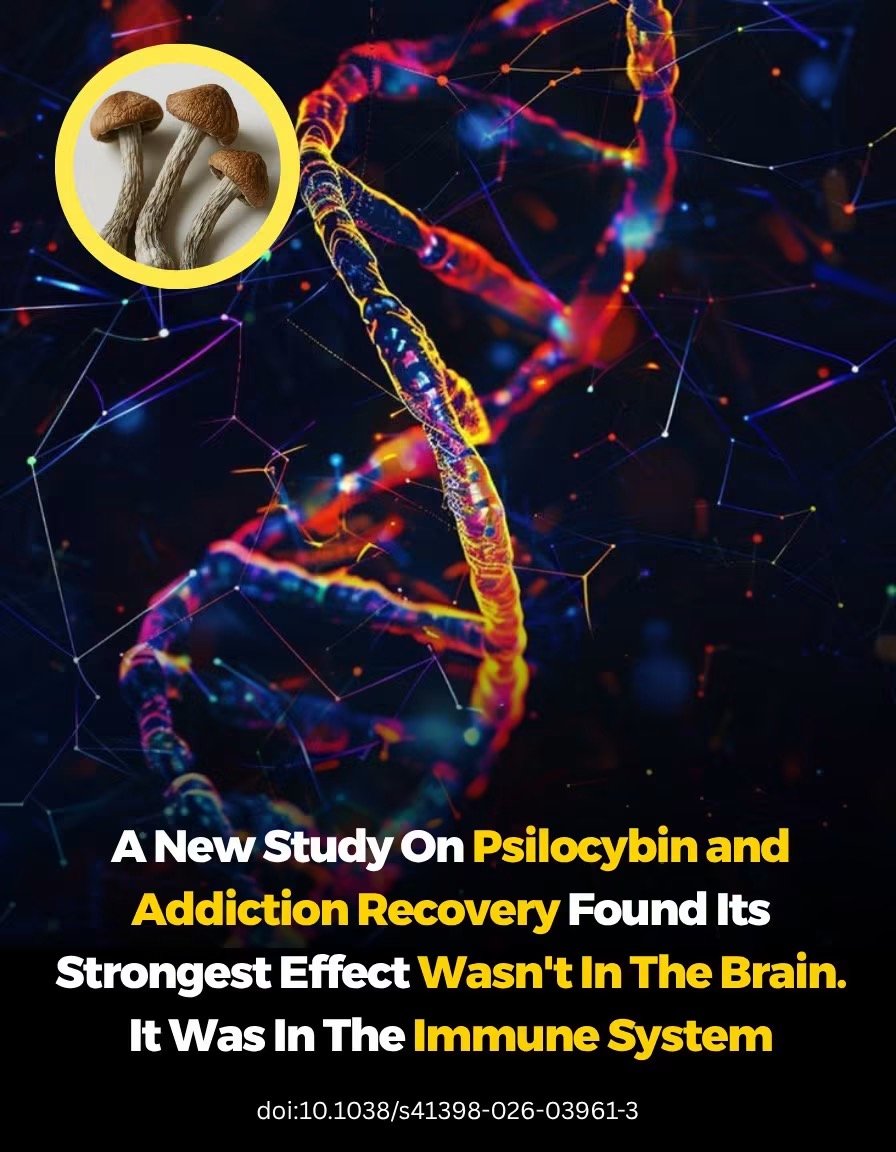
Psilocybin Alters DNA Methylation in Immune Genes, Not Brain
Bottom line: A single dose of psilocybin may alter DNA methylation in immune and inflammation-related genes, not the brain — a finding that could reshape how we understand its effects on mental health.
Somewhere on the internet right now, someone is swishing a chewed-up apple seed in their mouth, convinced it’s reading their DNA. The same logic has come for mushrooms — and untangling why it’s wrong leads somewhere far stranger than the myth.
In a small but provocative study, researchers found that a single 25 mg dose of psilocybin — the active compound in “magic” mushrooms — may be triggering changes in the body’s DNA methylation, but not in the brain. Instead, the most significant shifts were in genes tied to immune regulation and inflammation. This discovery, while preliminary, suggests that psilocybin’s effects may not be confined to the brain, but could be playing out in the body’s immune system as well.
A Surprising Target: Immune and Inflammatory Genes
The study, published in Translational Psychiatry, followed 37 people with alcohol use disorder (AUD) who received either a single dose of psilocybin or a placebo. One month later, researchers used an epigenome-wide association study (EWAS) to map changes in DNA methylation — a process that alters gene activity without changing the DNA sequence itself.
The results were unexpected. While psilocybin is known to target the serotonin 2A (5-HT2A) receptor in the brain, the most pronounced methylation changes were not in brain-related genes. Instead, they were in genes involved in immune regulation and inflammation signaling. These findings were not limited to a few isolated genes, but spanned multiple genetic regions that appeared to be working together in a network.
One of the most significant changes was found in a region of the genome near the RASGRP4 gene, which has been linked to immune cell signaling and inflammation. Another key site was identified in TLE4, a gene associated with cellular processes that can influence immune responses.
This suggests that psilocybin may be triggering a cascade of genetic changes that extend beyond the brain — potentially involving the body’s immune system. The implications are profound. If psilocybin’s therapeutic effects are partly mediated through immune and inflammatory pathways, it could open new doors for treating not just AUD, but a range of conditions tied to chronic inflammation, such as depression, anxiety, and even autoimmune diseases.
A Link Between Psilocybin and Psychological Change
The study also reported that the psilocybin group showed larger reductions in depression and hopelessness scores compared to the placebo group — a finding that aligns with previous research on psilocybin’s potential as a treatment for depression and AUD. However, the connection between these psychological changes and the observed methylation shifts in immune genes is still unclear.
What’s intriguing is that the changes in methylation were found a month after the single psilocybin dose — suggesting that the effects may be long-lasting. This aligns with earlier work suggesting that psilocybin could influence cellular aging and other biological processes tied to long-term health outcomes.
The researchers propose that the immune system may be acting as a bridge between the body and the brain, helping to sustain the psychological benefits of psilocybin. This is a tantalizing idea, but it remains to be tested in larger, more comprehensive studies.
The Mystery of the 5-HT2A Receptor
Despite the focus on immune and inflammatory genes, the study did not rule out the role of the brain. In fact, the researchers noted that changes were also seen near the 5-HT2A receptor, the primary target of psilocybin in the brain. However, these changes were not as pronounced as those in immune-related genes.
This raises a question: Could the brain’s response to psilocybin be secondary to the immune system’s reaction? Or could the two be working in tandem, with the immune system amplifying or modulating the brain’s response?
The answer is not yet clear. But the fact that immune-related genes showed such a strong response to psilocybin is a clue that the body’s immune system may be more deeply involved in the drug’s effects than previously thought.
A Glimpse into the Future of Psychedelic Medicine
This study is part of a growing body of evidence that is reshaping how we think about psychedelics. In 2025, another study suggested that psilocybin could influence cellular aging, potentially offering benefits that extend beyond mental health. Now, this new research adds another layer — the possibility that psilocybin may be working on the immune system as well.
If these findings are confirmed in larger studies, they could have major implications for the development of new treatments. For example, psilocybin could be used not just to treat AUD and depression, but also to manage conditions like chronic inflammation or autoimmune disorders — areas where current treatments are limited.
But for now, the evidence remains preliminary. The study was small (n=37), and the results are correlational rather than causal. The changes in methylation were observed at only one time point, and it’s unclear whether they persist over time or are reversible.
Frequently Asked Questions
Q: Does this study show that psilocybin is a treatment for immune-related diseases?
A: No. This study only shows that psilocybin may be associated with changes in immune-related genes. It does not prove that it can treat immune-related diseases.
Q: Could the immune system be responsible for the psychological effects of psilocybin?
A: This is a possibility, but it remains unproven. The study suggests a connection, but more research is needed to determine the exact role of the immune system.
Q: Is this the first study to show that psilocybin affects DNA methylation?
A: No. This is the first study to specifically examine psilocybin-induced methylation changes in people with AUD. Other studies have looked at methylation in the context of psilocybin’s effects on the brain and mental health.
Q: Could these findings lead to new treatments for depression or AUD?
A: Possibly, but only if future studies confirm these results and establish a clear link between methylation changes and therapeutic outcomes.
Q: Is this study reliable?
A: The study is well-designed and uses a rigorous EWAS approach. However, it is small and limited to a single time point. More research is needed before any conclusions can be drawn.
Sources
- ¶Epigenome-wide association study of psilocybin-induced methylome changes in alcohol use disorder
- ¶Epigenome-wide Association Study of Psilocybin-Induced Methylome Changes in Alcohol Use Disorder
- ¶Epigenome-wide association study of psilocybin-induced methylome changes in alcohol use disorder.
- ¶An epigenetic synopsis of parental substance use.
Educational Disclaimer
This article is for informational and educational purposes only. It is not medical advice, mental health advice, diagnosis, treatment guidance, or a recommendation to use any substance, supplement, therapy, or protocol.
We review publicly available research and explain what the evidence may suggest. Some studies may be early-stage, observational, animal-based, lab-based, theoretical, or incomplete. Always consult a qualified professional before making health-related decisions.
If you or someone you know is struggling, you are not alone. In the US, call or text 988 (Suicide & Crisis Lifeline). Elsewhere, contact your local emergency or crisis service.
Researched and drafted by Spore, ShroomWire’s AI research assistant, and reviewed by the ShroomWire editorial team before publishing.