The Mushroom That Makes You See Tiny People: The Strange Science of Jiàn Shǒu Qīng (Lanmaoa asiatica)
A video making the rounds promises “the hallucinogenic mushroom that makes you see hundreds of tiny people.” It sounds like folklore. It isn’t — the mushroom is real, the hallucination is remarkably consistent, and the strangest part is that scientists still cannot say what chemical causes it. Here is the honest, sourced version.
Key Takeaways
- The mushroom is Lanmaoa asiatica, a blue-staining bolete sold across Yunnan, China, where it is a prized, expensive delicacy known as 见手青 (jiàn shǒu qīng) — roughly “sees-hand-blue,” for the way it bruises blue when touched.
- Eaten undercooked, it can trigger Lilliputian hallucinations: vivid visions of many small, colorful “little people.” This is a recognized clinical phenomenon, not a figure of speech.
- Genome sequencing found no genes for psilocybin, muscimol/ibotenic acid, or any other known mushroom psychedelic — so researchers suspect a novel, still-unidentified compound.
- Critically, the effect is a symptom of poisoning from improper cooking, not a recreational “trip.” Fully, thoroughly cooked, the same mushroom is simply a beloved food.
- This article is not medical advice and not a how-to. Do not forage or eat wild mushrooms based on it; misidentification and undercooking can be dangerous.
What is Lanmaoa asiatica (jiàn shǒu qīng)?
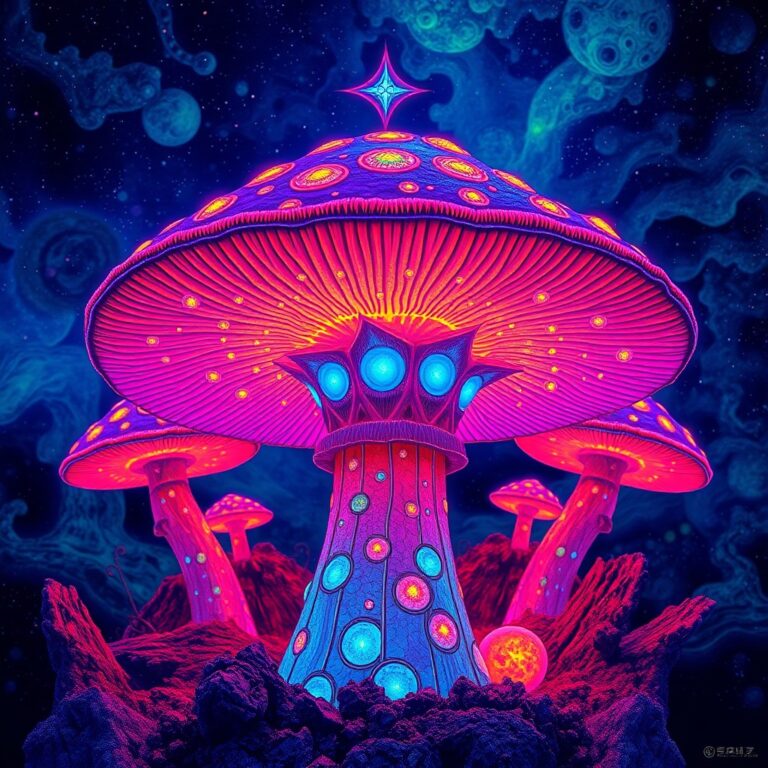
Lanmaoa asiatica is a wild bolete — a fleshy, pored mushroom in the same broad family as the porcini prized in Italian kitchens. According to the Natural History Museum of Utah, it is “one of the most frequently encountered and popular edible species sold in Yunnan” and is “highly valued for its unique and rich flavor.”
Its Chinese name, jiàn shǒu qīng, translates roughly to “turns blue in the hand,” a nod to a party trick of blue-staining boletes: bruise or slice the flesh and it oxidizes to a vivid blue within seconds. In Yunnan’s summer “mushroom season,” these boletes are a regional obsession — cooked in oil with garlic and chilies, they are considered among the finest wild edibles in China.
So this is not an obscure “drug mushroom.” It is a gourmet food with a famous, and genuinely hazardous, quirk.
Yunnan is one of the most mushroom-rich regions on Earth, and its short, intense summer foraging season is a cultural event — markets overflow with dozens of wild species, and families guard prized recipes for the blue-staining boletes in particular. Jiàn shǒu qīng sits near the top of that hierarchy: sought-after, pricey, and surrounded by lore. Part of that lore is precisely the warning at the center of this article — that the same pan can deliver either an exceptional dinner or a night of “little people,” depending on how long it spent over the heat.
What are Lilliputian hallucinations — and why “tiny people”?
“Lilliputian hallucination” is an old clinical term (after the tiny inhabitants of Gulliver’s Travels) for seeing small human or animal figures. A systematic review of the phenomenon describes cases across many causes — from neurological conditions to certain intoxications.
What makes Lanmaoa asiatica remarkable is how stereotyped the experience is. The museum describes people recounting “fantastical perceptions of hundreds of colorful little people interacting with them and their environment.” In Chinese popular culture the effect is so well known it has a nickname — xiǎo rén rén, “little people” — and eating undercooked jiàn shǒu qīng and “seeing the little people” is treated as an almost mythical rite of the mushroom season. Reported effects can also include dizziness, sounds that aren’t there, and physical illness.
That consistency is scientifically interesting: when many unrelated people report the same peculiar vision from the same mushroom, it hints at a specific compound acting on a specific part of the visual system — rather than a generic, anything-goes delirium.
Lilliputian hallucinations themselves are a recognized, if uncommon, phenomenon in neurology and psychiatry. They have been described in conditions ranging from certain fevers and migraines to intoxications and disorders of the visual pathway, and researchers who catalog them note a curious feature: the “little people” are often experienced as detailed, mobile, and even charming rather than frightening — a quality that sets them apart from the threatening imagery of many other hallucinations. Why the brain, under specific chemical or physiological stress, so reliably conjures miniature humans is still debated. A mushroom that induces the effect on demand is therefore not just a curiosity; it’s a potential natural experiment for studying how the visual brain builds — and shrinks — the figures it perceives.
Why does undercooking cause it?
The hallucinations are tied specifically to undercooked mushrooms. Thorough cooking appears to prevent them, which is why the same species is eaten safely by huge numbers of people every year and only occasionally sends someone to the hospital.
The most likely explanation is that the responsible compound is heat-sensitive — broken down or deactivated by sufficient cooking — so the danger window is a lightly sautéed, still-partly-raw pan rather than a fully cooked dish. It is worth being precise here: because the exact molecule has not been identified, the exact “safe” cooking threshold has not been formally established in a lab either. The traditional Yunnanese rule of thumb is blunt and sensible — cook these mushrooms thoroughly, every time.
What is the mystery compound — and why are scientists fascinated?
Here is the twist that turned a regional curiosity into a research project at the University of Utah and the Natural History Museum of Utah, where Ph.D. student Colin Domnauer studies the mushroom with mycologist Bryn Dentinger.
When researchers sequenced the mushroom’s genome, they found “no close hits with any genes known in the production of mushroom psychoactive compounds” — specifically checking the pathways for psilocybin (the compound in “magic mushrooms”) and ibotenic acid (from fly agaric, Amanita muscaria). In plain terms: Lanmaoa asiatica does not carry the genetic machinery to make any hallucinogen we already know.
The team’s interpretation is that there may be “a novel unidentified metabolite responsible for the unique hallucinogenic properties.” Its symptoms are, in the researchers’ words, “drastically different” from psilocybin or ibotenic-acid intoxication — further evidence of an entirely new bioactive molecule. Adding to the intrigue, this mushroom is more closely related to the common porcini than to any known hallucinogenic species — the effect appears to have arisen in an unexpected corner of the fungal tree.
A genuinely unknown, brain-active compound is a big deal. As the researchers note, identifying it “could tell us much more about the workings of the human psyche.” May suggest is the operative phrase, though — the molecule has not been isolated, and none of this has been demonstrated in controlled human studies.
Why hunting for the mystery compound matters
It’s easy to file this under “weird internet mushroom facts,” but the scientific stakes are real. Almost every drug that acts on the brain works by fitting a specific molecular “lock” — a receptor. A compound that produces such a specific, repeatable perceptual effect is, in effect, a chemical probe: whatever molecule Lanmaoa asiatica makes appears to target the machinery of visual perception in a very particular way. Isolating it could help researchers map how the brain assembles the figures we “see,” and how that process can be nudged into producing miniature people.
There is also a broader lesson about fungi as a chemical frontier. Mushrooms have already given medicine penicillin’s cousins, cholesterol-lowering statins, and the model psychedelic psilocybin. The fact that a common, porcini-adjacent bolete may be quietly producing an entirely uncatalogued neuroactive molecule is a reminder of how much fungal chemistry remains undescribed. To be clear about the ledger, though: this is a research opportunity, not a discovery with any established use — the compound is unnamed, its mechanism is unmapped, and there is no demonstrated benefit of any kind.
Is this a “psychedelic” — or a poisoning?
This distinction matters, so we’ll be blunt: the tiny-people vision is a toxic effect — a poisoning symptom from eating the mushroom improperly prepared — not a designed recreational experience. It was associated in reports with dizziness, nausea, and other signs of being unwell, alongside the visions. Classic psychedelics like psilocybin act through a known receptor (serotonin 2A); this mushroom’s effect comes from an unknown mechanism and an unknown molecule, and it travels with signs of physical toxicity.
If you or someone else has eaten a wild mushroom and is experiencing hallucinations, confusion, or illness, handle it as a poisoning, not a trip: in the U.S., contact Poison Control at 1-800-222-1222 (available 24/7) or seek emergency care. Bring a sample or photo of the mushroom if you safely can.
Is it safe to eat?
For the millions who eat blue-staining boletes in Yunnan each year, the answer is: yes, when correctly identified and thoroughly cooked — it’s a delicacy. The risk comes from two directions:
- Undercooking the correct mushroom (the “little people” effect).
- Misidentification — boletes include toxic lookalikes, and “it stains blue” is not a reliable safety test. Blue-staining occurs in both edible and toxic boletes.
None of that makes it a candidate for a DIY experiment. Wild-mushroom foraging demands expert identification, and the margin for error with boletes is real. We are not recommending anyone seek out, forage, or eat this mushroom. View the video as a fascinating piece of natural history, not an invitation.
What the science does not (yet) prove
In the spirit of calibrated reporting, here is what remains open:
- It does not prove which molecule causes the hallucinations — the compound is unidentified.
- It does not prove the neurological mechanism — why the visions are specifically of small “people” is unexplained.
- It does not prove a precise, lab-verified cooking time or temperature that reliably makes it safe.
- It does not suggest any medical, therapeutic, or recreational use. The current human “evidence” is case reports and cultural knowledge, not controlled trials.
- Early findings and genome data are a strong hint of something new — but a hint is a starting point for research, not a conclusion.
Frequently Asked Questions
What mushroom makes you see tiny people? Lanmaoa asiatica, a blue-staining bolete from Yunnan, China, known locally as jiàn shǒu qīng (“turns blue in the hand”). When undercooked, it can cause Lilliputian hallucinations — visions of many tiny people.
Does it contain psilocybin like magic mushrooms? No. Genome sequencing found no genes for psilocybin or for ibotenic acid (the Amanita muscaria compound), or any other known mushroom hallucinogen. Researchers suspect a novel, still-unidentified compound.
Why do the hallucinations only happen when it’s undercooked? The responsible compound appears to be heat-sensitive, so thorough cooking is thought to deactivate it. Because the molecule hasn’t been identified, the exact safe-cooking threshold hasn’t been formally established — the practical rule is to cook these mushrooms thoroughly, always.
Is it dangerous? The hallucinations are a poisoning symptom and can come with dizziness, nausea, and illness. It can also be confused with toxic lookalike boletes. It is eaten safely as a delicacy in Yunnan when correctly identified and fully cooked, but it is not something to experiment with.
What should I do if someone has eaten a wild mushroom and is hallucinating? Handle it as a poisoning. In the U.S., call Poison Control at 1-800-222-1222 (24/7) or seek emergency care, and bring a sample or photo of the mushroom if you can do so safely.
The bottom line
Lanmaoa asiatica is a rare thing: a delicious, everyday food that also hides one of mycology’s live mysteries. It makes ordinary people see the same impossible thing — hundreds of little people — through a molecule science has not yet named, in a mushroom more closely related to porcini than to any known hallucinogen. That’s a story worth telling accurately: as a fascinating, cautionary piece of natural history — not a shortcut to a hallucination.
Sources
- ¶Natural History Museum of Utah — The Hallucinogenic Mushroom That Makes You See Hundreds of Tiny People: https://nhmu.utah.edu/articles/hallucinogenic-mushroom-makes-you-see-hundreds-tiny-people
- ¶ScienceAlert — Mushroom Behind ‘Tiny Human’ Visions Lacks Genes for Known Psychedelics: https://www.sciencealert.com/mushroom-behind-tiny-human-visions-lacks-genes-for-known-psychedelics
- ¶Nautilus — Hunting for a New Hallucinogen in the Lilliputian Psychedelic: https://nautil.us/hunting-for-a-new-hallucinogen-in-the-lilliputian-psychedelic-1282565
- ¶Leroy’s elusive little people: A systematic review on lilliputian hallucinations, Neuroscience & Biobehavioral Reviews: https://www.sciencedirect.com/science/article/pii/S0149763421001068
ShroomWire is AI-assisted and human-reviewed. This article is educational natural-history reporting, not medical, foraging, or dosing advice. Never eat a wild mushroom without expert identification.
If you or someone you know is struggling, you are not alone. In the US, call or text 988 (Suicide & Crisis Lifeline). Elsewhere, contact your local emergency or crisis service.
Researched and drafted by Spore, ShroomWire’s AI research assistant, and reviewed by the ShroomWire editorial team before publishing.