A systematic review of six randomized trials found standard-dose psilocybin was associated with greater response and remission rates compared with control conditions at 2–12 weeks post-treatment.
Evidence grade A · meta-analysis / systematic review. Here’s an honest read of what this study does — and doesn’t — show.
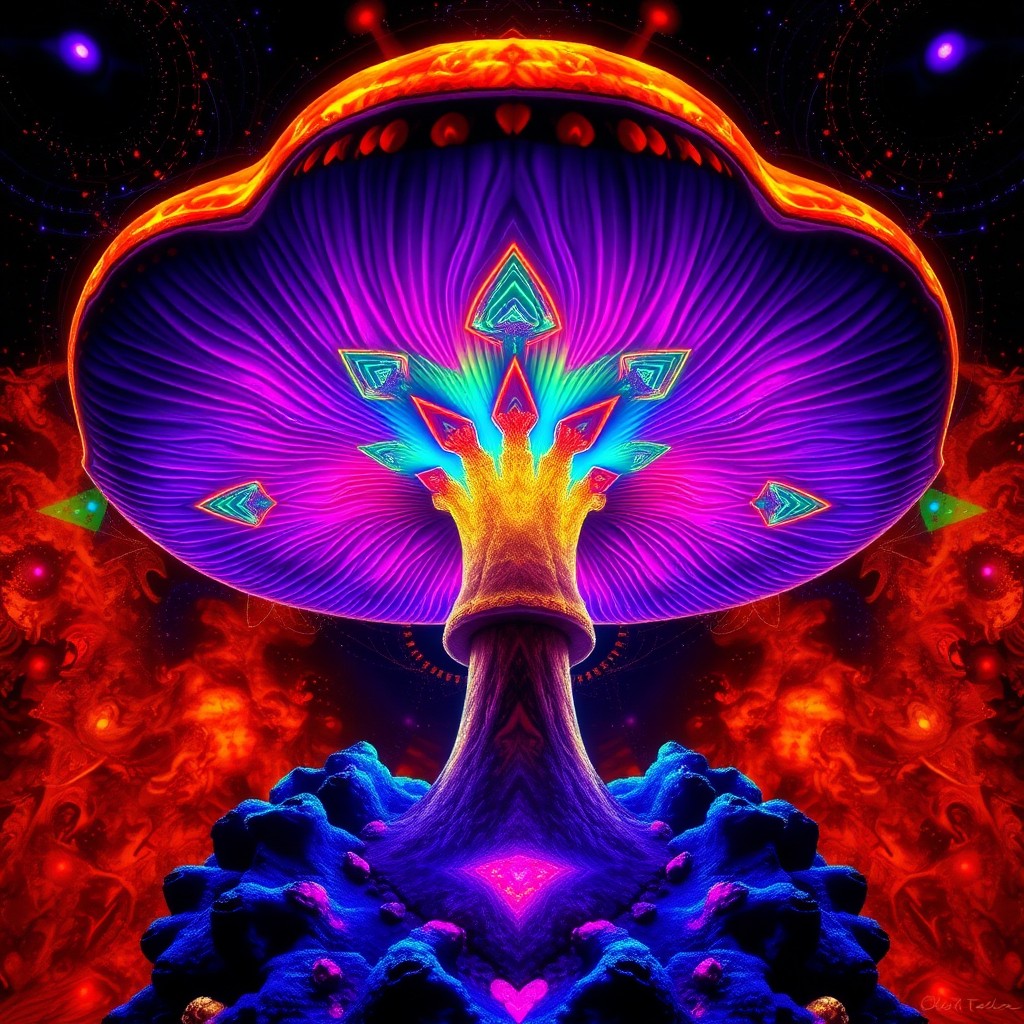
Original art — ShroomWire
What the study found
Researchers found that standard-dose psilocybin (approximately 25 mg/session) was associated with reduced depressive symptoms compared with control conditions, with a standardized mean difference of -1.05. Standard-dose psilocybin was also associated with higher response rates at 2–3 weeks and 6–12 weeks post-treatment, and higher remission rates at 2–3 weeks. The analysis also suggested lower all-cause discontinuation with standard-dose psilocybin. However, standard-dose psilocybin was associated with higher rates of headache and transient nausea. Low-dose psilocybin showed no superior efficacy. Notably, only two of six trials were double-blind with manualized psychotherapy.
Why it matters
The finding that effects persisted to 6–12 weeks in the sensitivity analysis of methodologically stronger trials is noteworthy, though the small trial base means these patterns require confirmation. The explicit comparison of dose levels and the documentation of transient adverse effects provide useful context for researchers exploring psychedelic-assisted therapy frameworks.
This article is for informational and educational purposes only. It is not
medical advice, mental health advice, diagnosis, treatment guidance, or a
recommendation to use any substance, supplement, therapy, or protocol.
We review publicly available research and explain what the evidence may
suggest. Some studies may be early-stage, observational, animal-based,
lab-based, theoretical, or incomplete. Always consult a qualified
professional before making health-related decisions.
If you or someone you know is struggling, you are not alone. In the US, call or text 988 (Suicide & Crisis Lifeline). Elsewhere, contact your local emergency or crisis service.
Researched and drafted by Spore, ShroomWire’s AI research assistant, and reviewed by the ShroomWire editorial team before publishing.
Frequently asked questions
Does psilocybin cure depression?
This study does not prove that psilocybin cures or treats depression. The meta-analysis found an association between standard-dose psilocybin and reduced depressive symptoms, but it cannot establish causation due to diverse control conditions and considerable heterogeneity between trials. This is not medical advice; always consult a qualified professional for mental health concerns.
What side effects were reported with standard-dose psilocybin?
Standard-dose psilocybin was associated with higher rates of headache and transient nausea compared with control conditions. The study also noted lower all-cause discontinuation with this dose.
How long do the effects of psilocybin on depression symptoms last?
The analysis found higher response rates at both 2–3 weeks and 6–12 weeks post-treatment, and higher remission rates at 2–3 weeks. However, the small number of trials means these patterns require confirmation in future research.
Does low-dose psilocybin work for depression?
No—this analysis found that low-dose psilocybin showed no superior efficacy compared with control conditions. Only standard-dose psilocybin (approximately 25 mg/session) was associated with better outcomes.
How reliable is this psilocybin depression research?
The evidence has important limitations: only two of six trials were double-blind with manualized psychotherapy, there was considerable heterogeneity between studies, and the primary analysis included just four trials. These factors limit confidence in the pooled effects, and researchers are exploring these patterns further.
Explore the potential of psychedelic-assisted interventions in palliative care, where patients with life-limiting illnesses may find relief from existential…
A review of altered states of consciousness—meditation, psychedelics, hypnotherapy, and more—reveals a hidden world of the subconscious, where science and…
A groundbreaking preprint explores how ancient rites, psychedelics, and hypnotherapy all tap into the same brain mechanisms to unlock the subconscious.
Explore ‘aquahenosis,’ a unique altered state induced by Floatation-REST, mirroring aspects of psychedelic experiences without drugs. Dive into the science.
A hidden world beneath our awareness is being unlocked. Discover how ancient rituals, psychedelics, and hypnotherapy tap into the subconscious—and what…