Golden Teacher: How One Strain Became the Face of Psilocybin
If you’ve heard the name of exactly one psilocybin mushroom, it’s probably Golden Teacher. It’s the most recognizable strain of Psilocybe cubensis, the most widespread psychoactive mushroom species. The interesting story here isn’t how to grow it — we’re not covering that — it’s how a single strain became a cultural icon, and how it does (and doesn’t) connect to the science making headlines.
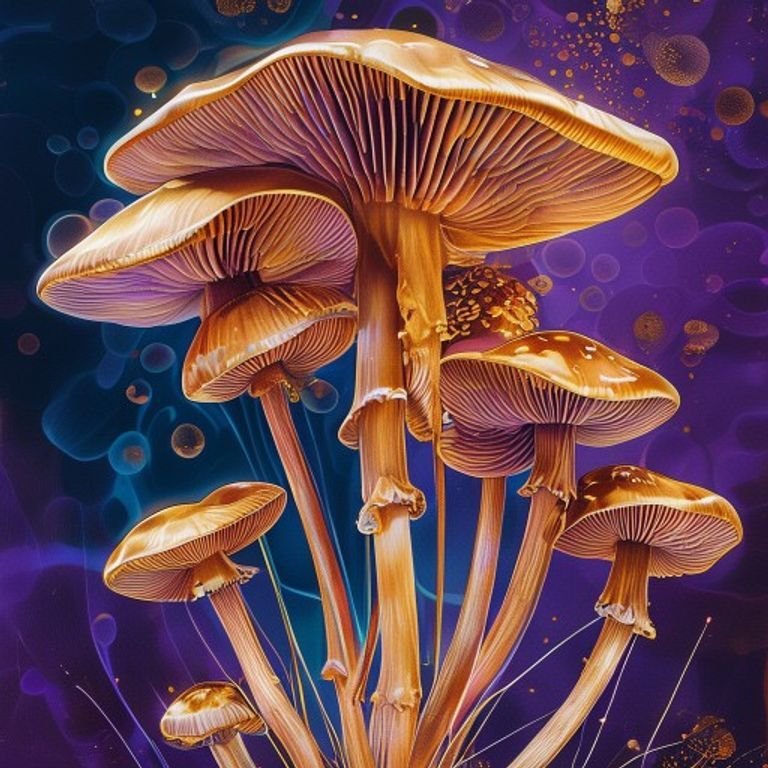
What it actually is. Golden Teacher is a strain — a cultivated variety — of P. cubensis, recognized by its golden-caramel caps. The name nods both to that look and to the reflective, “instructive” character users have long described. Its origins are genuinely murky: it surfaced in the cultivation scene in the late 1980s, variously attributed to a wild Florida specimen or a renamed Hawaiian variety, with no definitive source ever confirmed.
Why it became iconic. By the 1990s it was the most-discussed cubensis strain online and the one nearly every newcomer heard of first. The reasons are more cultural than chemical: a reputation for consistency, plus availability and community lore. Its potency is typical for the species — what set it apart was trust, not unusual chemistry. Three decades later, it’s still the default reference point.
The part people get wrong
Here’s the myth worth busting. The psilocybin in the clinical trials you read about — for depression, end-of-life distress, addiction — is almost always pharmaceutical-grade synthesized psilocybin, not Golden Teacher or any strain. Whole mushrooms vary in psilocybin content by genetics, growing conditions, and storage, so regulators require a precisely dosed, reproducible compound. So “Golden Teacher” is a story about cultivation culture; the clinical science is strain-agnostic. (Curiously, in mycology literature it does serve as a common baseline for comparing cubensis strains — simply because it has the most accumulated data.)
What research is exploring — and the limits
Psilocybin the molecule is under study for conditions like treatment-resistant depression, with some promising early-stage results. But it remains investigational, not approved, and the trials test the compound, not a strain.
The legal and safety reality: psilocybin and psilocybin-containing mushrooms are controlled substances — Schedule I federally in the U.S. and illegal in most countries; cultivation and possession carry real legal risk. This piece is cultural and scientific context only — not a grow guide, not dosing or medical advice, and not encouragement to obtain or use anything.
Sources
- Psilocybe Cubensis: Origins, Effects & Why It’s Called “Golden Teacher” — Beckley Retreats
- Is There More to Magic Mushrooms than Psilocybin? — PMC review (2025)
- Psilocybe cubensis — Wikipedia
ShroomWire Research Desk · AI-assisted, human-reviewed · persona: Spore. We report what research may suggest and what it does not prove.