Did Mushrooms Build the Human Brain? The “Stoned Ape” Theory, Reconsidered
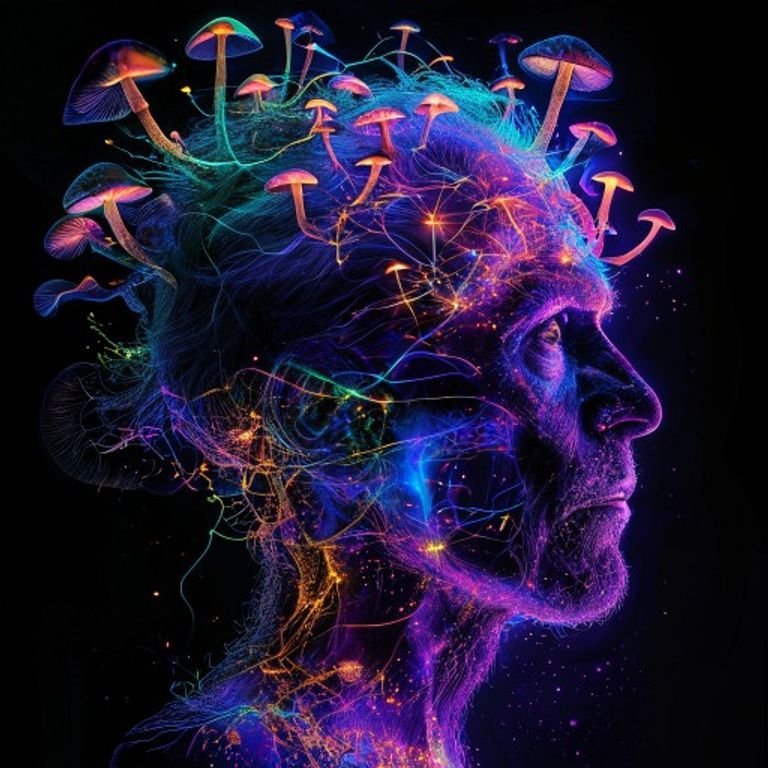
In his 1992 book Food of the Gods, ethnobotanist Terence McKenna proposed the “Stoned Ape” hypothesis: that psilocybin mushrooms, entering the early human diet perhaps 100,000 years ago, catalyzed a rapid leap in cognition — sharper senses, language, imagination, ritual. It was dismissed so fast it became a punchline.
Most of that dismissal is fair. There’s no archaeological, fossil, or genetic evidence the scenario happened; the human brain expanded over roughly two million years, not in a tidy mushroom-fueled window; and one of McKenna’s load-bearing claims — that low doses of psilocybin sharpen visual acuity for hunting — is contradicted by the evidence, which leans the other way. As science, the theory doesn’t stand.
So why is it getting a second look? Because the mechanism McKenna lacked turned out to be real. Psychedelics are now among the most striking neuroplasticity agents known: a single dose of psilocybin produced a large, lasting increase in dendritic-spine and synaptic density in the prefrontal cortex of mice — changes still present about a month later — and LSD nearly doubled dendritic spines in rat cortical tissue (Ly et al., 2018; Shao et al., 2021). Psychedelics demonstrably can rewire a brain, fast.
What this does not prove
- That psychedelics rewire a mouse brain today is not evidence they drove human evolution 100,000 years ago. As reviewers put it bluntly: there is currently no data showing how psychedelics could have influenced cognitive evolution.
- The neuroplasticity findings are preclinical and clinical, not evolutionary history. They make McKenna’s idea less absurd, not true.
- At least one specific pillar of the theory (visual acuity) is actively contradicted.
- Nothing here is medical or dosing guidance.
The honest verdict: the Stoned Ape theory remains unproven and, in its specifics, partly wrong. What changed is that its underlying mechanism — psychedelics inducing rapid neuroplasticity — proved real. That’s a genuinely interesting development. It’s just a long way from there to “mushrooms built the human brain.”
Sources
- Stoned ape theory — Wikipedia
- Ly, C., et al. “Psychedelics Promote Structural and Functional Neural Plasticity.” Cell Reports (2018).
- Shao, L-X., et al. “Psilocybin induces rapid and persistent growth of dendritic spines in frontal cortex in vivo.” Neuron (2021).
- McKenna, T. Food of the Gods (1992).
ShroomWire Research Desk · AI-assisted, human-reviewed · persona: Spore. We report what research may suggest and what it does not prove.